What a City Loses When Its Repair Shops Close
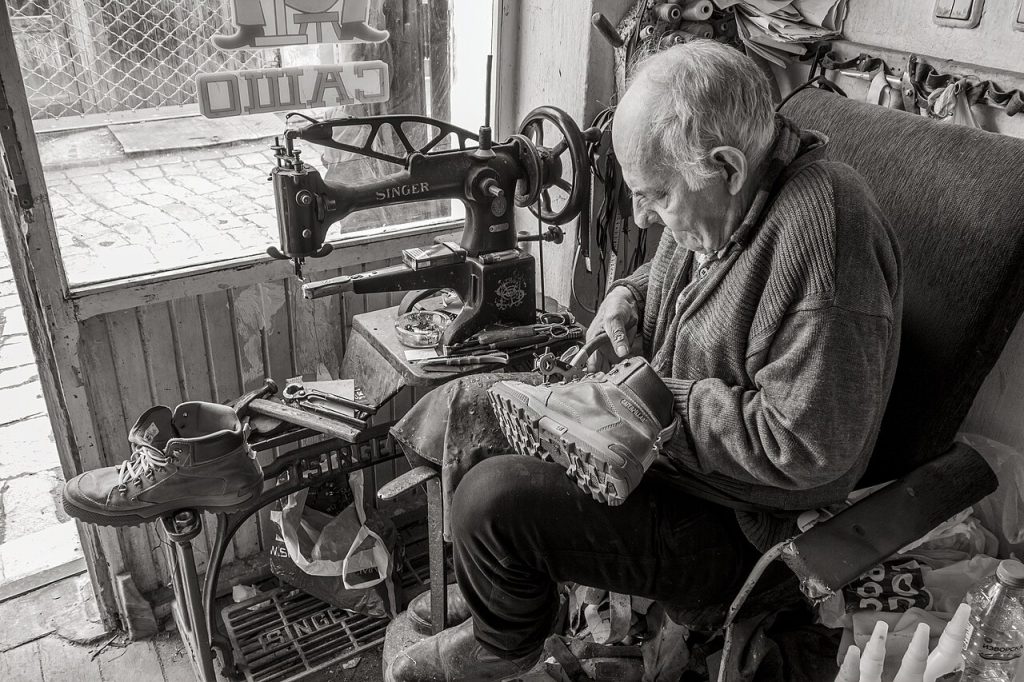
A city keeps two kinds of memory. One is in its museums, catalogued and lit; the other is in its workshops, uncatalogued and usually closing. The second disappears with less comment, because a repair shop does not announce itself as heritage until the shutters are down.
The diagnostic hour
A cobbler reads a pair of shoes the way a doctor reads a gait. Wear on the outer edge of the sole suggests a foot that rolls outward; a heel worn on one corner suggests the opposite; a crease across the vamp that has gone white shows leather that has dried past recovery. From that reading comes an estimate, and the estimate is a judgement not only of cost but of whether the object deserves the labour.
That judgement is the part customers rarely see and the part that takes years. Knowing that a cemented sole can be rebuilt but will never be worth rebuilding twice, that a welted sole can take three or four replacements before the upper fails, that a heel tip replaced early saves the heel block underneath, is a form of knowledge that only exists at a bench, in a room that smells of glue and leather dust.
Parts and the end of parts
The trade has always depended on parts, and parts are being withdrawn. A watchmaker keeps drawers of donor movements because the manufacturer stopped supplying a calibre twenty years ago; a lamp repairer keeps boxes of switches and sockets in shapes nobody makes now; an umbrella is a set of ribs, a runner and a canopy, and three of those four can be replaced if anyone still stocks them.
This is where the argument about repair stops being sentimental and becomes structural. A sealed unit, a proprietary screw, a battery bonded into a case: each is a decision that ends a relationship at the factory gate. Legislation has begun to push back in some places, but statute tends to arrive after the skills have gone, and a right to repair is not much use in a city with nobody left to do it.
The rent problem
Repair is a low-ticket, high-labour business, which makes it uniquely vulnerable to rent. A cobbler might charge the price of a modest dinner to save a pair of shoes that cost several hundred, and the arithmetic only works if the square metre is cheap. When the street improves, the shop moves to the edge of the district; when it moves twice, the customers who came on foot stop coming, and a business built on a ten-minute radius quietly loses its base.
The survivors cluster for a reason. They sit near tailoring, near theatres, near the kind of wealth that keeps objects rather than replacing them, and near the workshops that serve hotels and wardrobes. Convenience is the whole product. A repair that requires a train journey is a repair most people will not commission, however much they believe in the principle.
What is actually lost
Vocabulary goes first. A customer who cannot name a half sole, a blake stitch, a re-last, a French heel, cannot describe what is wrong, and a customer who cannot describe the problem cannot ask for it to be solved. The language of making and the language of mending are the same language, and both thin out at the same rate.
Then the apprenticeship. Four years at a bench, mostly watching, is how the knowledge transfers, and there is no bench without a shop. The last generation in a trade is usually visible in advance: one person, near retirement, taking fewer jobs because the body hurts and no one has asked to learn. When that person stops, the skill does not move to a school. It simply ends, and a city that could once resole a shoe can now only sell one.
Who keeps it alive
The demand has not vanished so much as concentrated. Theatre wardrobes, hotel housekeeping, uniform contracts, museum costume departments and archives all need things maintained rather than replaced, and they need it on a schedule with an invoice. These are the customers who keep a bench occupied, and they are rarely the ones a neighbourhood notices.
Then there are the individuals who own one good coat and intend to keep it, and who have worked out that the cost of maintenance is lower than the cost of replacement once the replacement is also good. Their number is small and their loyalty is total. A shop with forty such customers and two institutional accounts can survive a rent rise; a shop with only the first cannot.
The drawer of odd screws behind a repair counter is a kind of archive, organised by nothing but the memory of the person who filled it. Nobody will ever catalogue it, and when it is tipped into a skip the city will lose a reference library it did not know it had. The loss will not appear in any survey of cultural infrastructure, and the shoes will still be thrown away, one pair at a time, by people who would have preferred to keep them.