Why Mouth-Blown Crystal Costs What It Costs
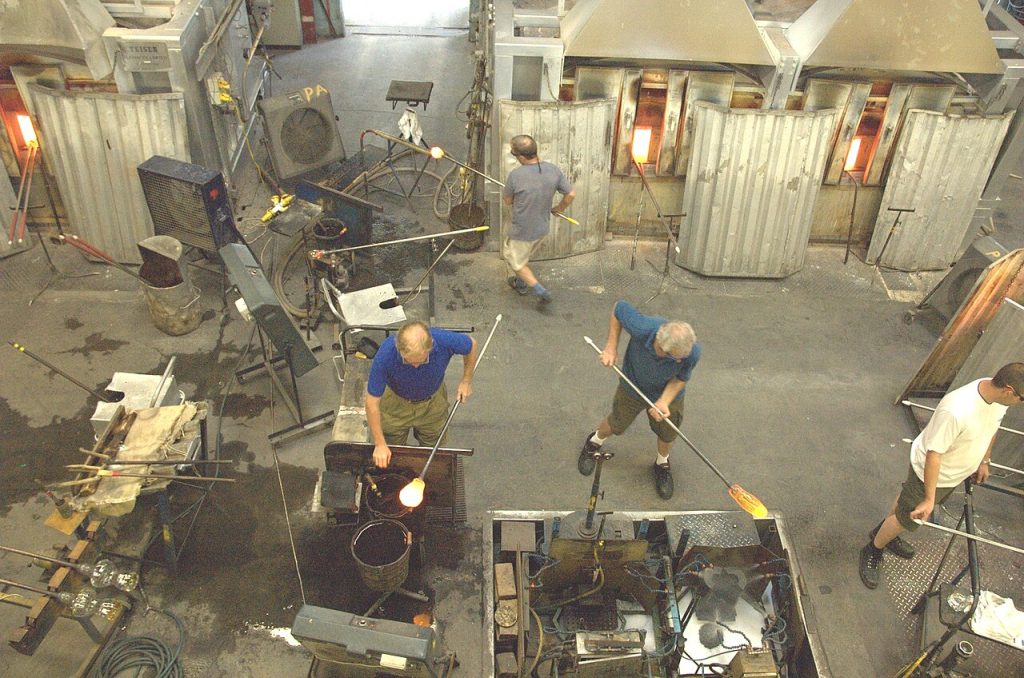
A mouth-blown glass passes through six pairs of hands before it reaches a table, and any one of them can destroy it. The price is an accounting of hours and losses, and the bell-like ring that sells it is a side effect of the recipe rather than its purpose.
What lead did
Lead oxide, at around twenty-four per cent, changes glass in three useful ways: it raises the refractive index so that cut facets throw more light, it increases density so the object feels heavier in the hand, and it softens the material so that a wheel bites cleanly instead of chipping. The ring comes from the same softness and density, which is why a lead crystal glass sounds different when flicked and why the sound became a marketing device.
Lead-free crystal has improved enormously and now dominates the market for reasons of regulation, export and consumer preference. Formulations using potassium, barium and zinc can reach a similar refractive index, and a skilled cutter will say the difference is in how the glass behaves under the wheel rather than in how it looks afterwards. The old material was more forgiving; the new one demands a lighter touch, and the best workshops have adjusted rather than complained.
The gather and the mould
The furnace runs continuously at around eleven hundred degrees, and the gatherer takes a ball of molten glass on the end of a blowpipe, turns it on the marver to cool the outside, and begins to shape it with a breath. For a stemmed glass the bowl is blown into a metal or wooden mould to set the outer profile, then the foot is applied from a second gather, then the piece is transferred to a punty rod so the mouth can be opened and the rim finished.
Each transfer is a moment of risk. The glass is at the edge of its working range, the punty has to attach without distorting the bowl, and the join leaves a mark that must be ground away later. The whole sequence takes a few minutes, and the timing is learned by the body rather than the head: a second too long and the piece slumps, a second too soon and it will not hold its shape.
The lehr
Annealing is the part nobody watches. The finished glass goes into a lehr, a long tunnel with a controlled temperature gradient, and cools over eight to fourteen hours. Cool it faster and the outside sets before the inside, stresses lock into the wall, and the glass will one day fail, usually at the foot, usually in a dishwasher, usually without warning.
This is why cheap crystal breaks in ways that seem disproportionate to the knock it received. The failure was installed at the factory, and the chip at the base is simply the day the stress found its exit. A well-annealed glass can be dropped on a wooden floor and survive; a badly annealed one can fail while being dried.
The wheel
Cutting is where the labour concentrates. A cutter works at a horizontal spindle with a rotating wheel, roughing the pattern with a coarse abrasive, smoothing with a finer one, and polishing with cork or felt charged with pumice and cerium oxide. A single tumbler with a complex pattern can take twenty to forty minutes, and the pattern itself may run to twenty facets that must meet at consistent angles.
The training is long. An apprenticeship of five to eight years is normal before a cutter is trusted with the full catalogue, and the first years are spent on straight cuts and on scrap. The skill is not only in the hand but in the eye, because the pattern is judged by how the light travels through the finished wall, and a facet that is a degree out will read as dull from one side of the table and bright from the other.
Machine and hand
Pressed glass is made in a single operation, with the mould forming both the shape and the pattern, and it is a legitimate industrial product. Its tells are consistent: a seam where the mould halves met, a wall of even thickness where a blown piece thins toward the rim, and a base without a pontil mark. None of these is a defect. They are simply the signature of a different process, and a buyer who knows them can price a glass in the hand.
Between the two sits a large honest middle: glass blown by machine into a mould and then cut by hand. It gives the lightness and the thin rim of a blown piece with the consistency of an industrial one, and it is where most serious tableware now lives. The distinction that matters to a table is not hand against machine. It is whether the rim was fire-polished or ground, whether the balance is right, and whether the bowl was designed for the wine it will hold.
Failure
Breakage is built into the price. A workshop making a thin-stemmed glass will lose a percentage at the punty, a percentage at the rim, a percentage in the lehr, and a further percentage in packing, and the surviving pieces carry the cost of the dead ones. Seconds are sold off at a discount with a ground mark or a shop’s own label, which is why the same shape can appear at two prices with no visible difference to an untrained eye.
A glass dies at the table, usually by a knock against a water jug, and the loss is total because a chipped rim cannot be repaired invisibly. That fragility is not a flaw in the design; it is the price of a thin rim, which is the part that makes the object pleasant to drink from. The trade is explicit, if rarely stated: the buyer purchases something that will break, and pays for the hours that made it worth keeping until it does.