What a Lipstick’s Finish Says About Its Formula
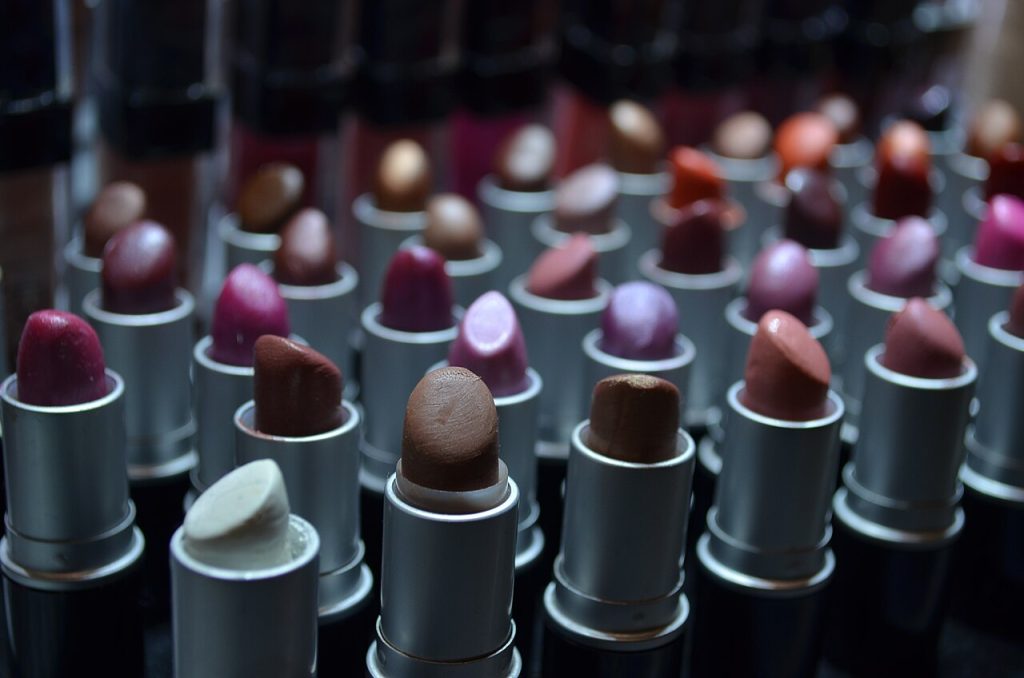
A lipstick is a suspension, not a colour. Pigment sits inside a matrix of wax and oil that has to stay solid at room temperature and soften at body heat, and almost everything a counter calls a finish is a ratio between those two jobs.
Four materials and one structure
The waxes set the architecture. Beeswax, candelilla and carnauba melt at very different temperatures, and carnauba, the hardest of them, is what keeps a bullet from collapsing in a warm room. The oils do the opposite work: castor has been the standard for a century because it is viscous, wets pigment well and does not go rancid quickly, and jojoba, lanolin and various esters adjust the feel on the lip. Pigment is usually iron oxide, a lake or carmine, and the fillers, silica and kaolin and mica, decide how much light comes back.
Pigment load separates the categories more reliably than any name. A sheer balm may carry eight per cent colour; a full matte can run past twenty-five, and at that concentration the formulator is no longer making a tint but a compressed powder held together with fat. Everything else in the formula exists to stop that powder from cracking.
What keeps the bullet standing
The wax ratio and the drop point decide whether the object survives a handbag. A soft bullet glides and slumps; leave it in a car in summer and it leans. A hard bullet survives and drags, and drag is the most common reason a well-pigmented lipstick is abandoned after a week. The compromise is usually reached at a texture the industry calls creamy, which means soft enough to deposit colour in one pass and hard enough to hold a slant.
Temperature cycling is the hidden test. A bullet that leaves the factory in winter and crosses three climates before it reaches a shelf has been through repeated softening and setting, and the wax crystals change each time. Reformulations that appear to change nothing are often about this, not about shade.
Matte is a subtraction
Matte is not an added quality. It is what remains when the oils are reduced and the fillers increased so that the surface scatters light instead of reflecting it. The result is opaque, long on the lip and low on transfer, and it asks the mouth to supply the moisture the formula no longer provides. A matte that feels comfortable has usually been rebalanced with a light emollient, which costs a little of the flatness.
Shine works the other way. A gloss carries film formers and non-volatile oils that sit on the surface, and anything that sits on a surface moves. The physics is unglamorous: a substance that softens at lip temperature will transfer to a cup, and no claim on the box changes the melting point.
The volatile trick
Long wear is usually achieved with a volatile silicone that evaporates after application and leaves pigment bound in a resin film. For the first minute the product feels fluid; afterwards it feels like nothing, which is both the appeal and the problem, because nothing does not moisturise. Wear claims are measured under conditions that resemble a laboratory more than an afternoon, and the number on the package should be read as a ceiling rather than an average.
The comfort debt is real. Most long-wear products assume a balm underneath, and the brands that sell both know it. Whether that counts as engineering or as selling two things where one might do is a fair question, and the answer depends on whether the wearer wants a formula or a procedure.
Shade, opacity and the mirror
Opacity changes what a colour appears to be. A translucent red reads deeper on the lip than in the bullet because the mouth’s own colour sits underneath it; a fully opaque red reads exactly as it looks. This is why the same shade number can disappoint in a sheer version and satisfy in a matte, and why counters light their mirrors warm, where almost everything reads softer than it will outdoors.
The used bullet is the most honest record in the category. It wears into a slant that follows one person’s mouth, the flat edge from the upper lip, the ridge from pressing too hard at the corner. No advertisement shows that shape, and it is the only part of the object that could not be photographed for a campaign.
What the finish sells is temperament, and what the formula sells is a set of physical compromises that the wearer lives with daily. The two are related but not identical, and the gap between them is where most dissatisfaction begins. A person who knows they want slip will be unhappy with a matte no matter how good it is, and no amount of shade naming will fix that.