Inside the Atelier: How a Hermes Scarf is Born
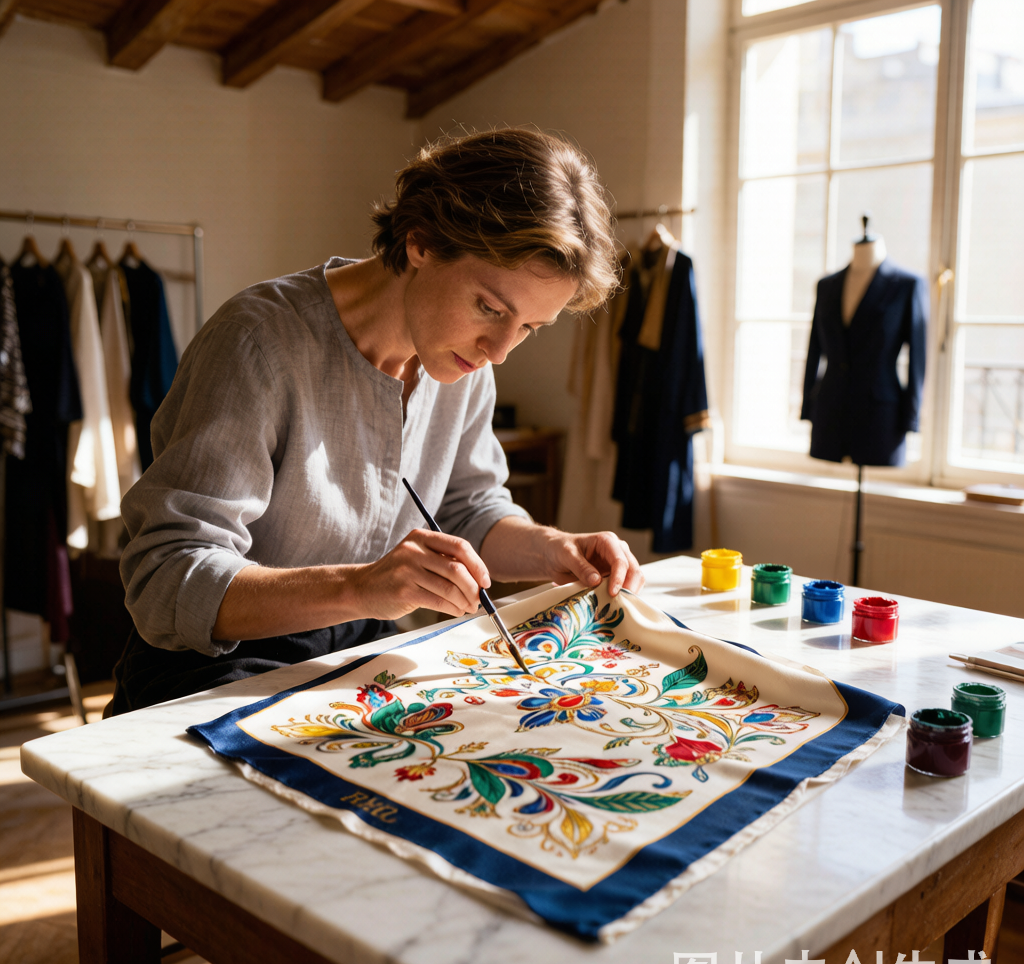
The most coveted piece of silk on earth begins not on a runway, but in a garden outside Lyon.
Every Hermes scarf tells a story. But the story most people never hear begins eighteen months before the scarf reaches the boutique, in a sunlit studio where an illustrator paints a tiger in gouache, unaware that her brushwork will eventually be broken into forty-seven separate screens, each a single colour in the final print.
This is not manufacturing. This is a form of generosity so extravagant it borders on obsession.
The Year of the Artist
Hermes commissions roughly twenty new scarf designs each year from a rotating stable of creatives: painters, illustrators, even architects moonlighting in silk. The brief is deliberately vague: a theme, perhaps nature, perhaps mythology, perhaps a city, and complete creative freedom within the ninety-by-ninety-centimetre square. The artist spends six months to a year developing the design.
The final artwork is a full-scale gouache painting. Not digitised. Physically delivered to the Hermes atelier in Lyon, where a colourist, a position so specialised it barely exists elsewhere on earth, begins deconstructing it. Every shade is isolated, numbered, and translated into a pigment recipe. A design with forty-seven colours requires forty-seven separate screens, each engraved by hand onto a silk mesh frame. This can take seven hundred hours per design.
The Silk Itself
Hermes sources silk from a single supplier in Brazil. The threads are woven to Hermes own specification: 450,000 kilometres of silk thread go into a single year of scarf production. The resulting fabric, a specific weight and weave called Hermes twill, is washed, dried, and inspected under light tables by women whose eyes have been trained to detect flaws invisible to the untrained observer.
Each colour is applied one screen at a time. A scarf with forty-seven colours passes under forty-seven screens, each laying pigment to a tolerance of roughly one-tenth of a millimetre. The process takes about eighteen months from painting to boutique. At the end, the scarf contains approximately 27,000 kilometres of silk thread, the labour of dozens of artisans, and the vision of a single artist who never intended her work to be worn around a neck.
Why This Matters
In an era where luxury goods are increasingly produced in the same factories as mid-market products, the Hermes scarf operation is an act of defiance. The company could digitise the process. Reduce the colour count. Shorten the timeline. It refuses. Because Hermes understands something most luxury conglomerates have forgotten: the product is not the scarf. The product is the impossibility of the scarf.
That is why a piece of silk costs more than some smartphones. You are not buying a fashion accessory. You are buying a system of production so wilfully inefficient that its inefficiency has become the entire value proposition.
The Bottom Line
The Hermes scarf is a perverse luxury. A product that could be made for a fraction of the cost, in a fraction of the time, and the only reason it is not is because Hermes has decided the long way is the only way. In a world chasing shortcuts, there is something deeply satisfying about a company that refuses to take them.