What a Rug’s Knot Count Reveals About Its Making
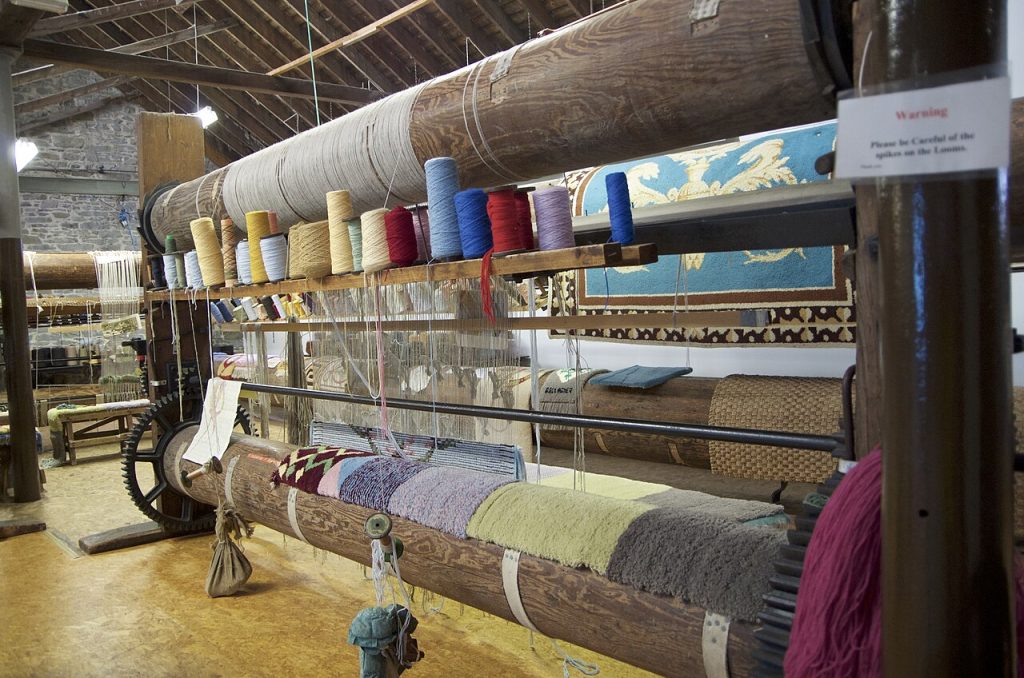
A hand-knotted rug is a calendar. Every square inch records a fixed number of decisions, and the arithmetic of a large carpet runs into years before anyone has washed it. The knot count is the number the trade quotes, and it is the least informative number available.
The knot and the count
Two knots do most of the work. The symmetric knot, sometimes called Turkish, wraps around two warp threads and returns on either side of them; the asymmetric, or Persian, wraps around one and is held by the neighbouring thread. Both are tied by hand, one at a time, across the width of the loom, and a row of weft is beaten down after every few rows to hold them. Density is measured in knots per square inch, and the range runs from around sixty in a coarse village rug to well over a thousand in a fine silk Hereke.
The arithmetic is sobering. A carpet of three by four metres at five hundred knots per square inch contains somewhere near six million knots. Two experienced weavers, working six days a week, will take the better part of two years, and the loom will occupy the whole of a room for that time. This is why knot count functions as a proxy for labour: it is the only figure on the label that translates directly into hours.
Wool, lanolin and altitude
The material matters more than the density, and the best wool comes from sheep kept high and shorn in spring, when the fleece is long and the lanolin has not been washed out by weather. Hand-spinning preserves the fibre’s crimp and leaves a slight irregularity in the yarn, which is why a hand-spun pile resists crushing where a machine-spun one flattens. Silk is used for highlights, and in some workshops for the entire field, where the point is a surface that changes with the angle of the light.
Dyeing is a separate craft with its own chemistry. Madder root, indigo, cochineal, walnut husk and pomegranate rind each need a mordant to fix, and the mordant, the water and the pot all shift the result. A dyer working from the same recipe in two seasons will produce two colours, which is either a defect or the signature of the method, depending on who is selling.
Abrash, the record of dyeing
That variation has a name. Abrash is the subtle change of tone across the field of a rug, visible as a soft line where one batch of dyed yarn met the next. In the trade it is read as evidence of hand dyeing, and in the best weaving it is used deliberately, planned into the colour sequence so that the shifts run across the rug rather than appearing as an accident in one corner.
Machine-dyed wool is uniform, so the industry prints and washes imitations of abrash onto new rugs, which is one of the more legible dishonesties in the category: a finish applied to look like a process that was skipped. The imitation usually gives itself away by repeating, since a printed line has a period and a dyed one does not.
The cartoon and the colour plan
Before any knot is tied, the design is drawn on graph paper, one square to one knot, and coloured. A complex classical carpet may carry twenty-five or thirty colours, and the cartoon is the master weaver’s score: which knot, which colour, where the line changes. On a fine rug the weaver works from memory of the row rather than from constant reference, calling the colours aloud to a partner, and the two of them keep the pattern in their heads for months.
Two rugs woven from the same cartoon will not be identical. The tension of a hand, the settling of the wool after washing, the small deviations in a repeated border motif: all of it accumulates. The deviations are the reason a hand-knotted rug can be read at a glance by someone who has handled a few thousand, and the reason a good copy is more difficult to make than it looks.
Finishing
When the last row is beaten down the rug is cut from the loom and the work that decides its final character begins. The pile is clipped to an even height, by hand with shears on the better pieces, which takes days and cannot be hurried without leaving tracks. Then it is washed, sometimes with soap and water, sometimes in a river, and laid in the sun to dry, and the washing both cleans the wool and sets the pile.
The back of a rug is the honest side. There the knots are visible in their thousands, the weft lines run straight or do not, and the density can be counted with a ruler rather than trusted from a label. Dealers turn rugs over before they look at the face, and anyone buying one should do the same, because the front can be clipped and patched and the back cannot lie.
What the number cannot say
A high knot count is a necessary condition of fine work and a poor description of it. A tightly knotted rug in bad wool with a muddy colour plan is a technical exercise, and a moderately knotted rug with good wool, well-spaced drawing and a coherent palette will outlive it and look better doing so. Density is easy to test, which is why it became the number the market quotes; design and material are slow to judge, which is why they are mentioned second.
The consequence is a market that rewards the measurable. Weavers are pushed toward finer knots and faster work, and the qualities that cannot be counted, the drawing, the wool, the patience in the dye pot, are the first to be economised. A rug is not a specification. It is a surface that will be walked on for eighty years, and it will be judged by how it wears, which no label can predict.