Why Vegetable-Tanned Leather Ages Better Than Anything Else
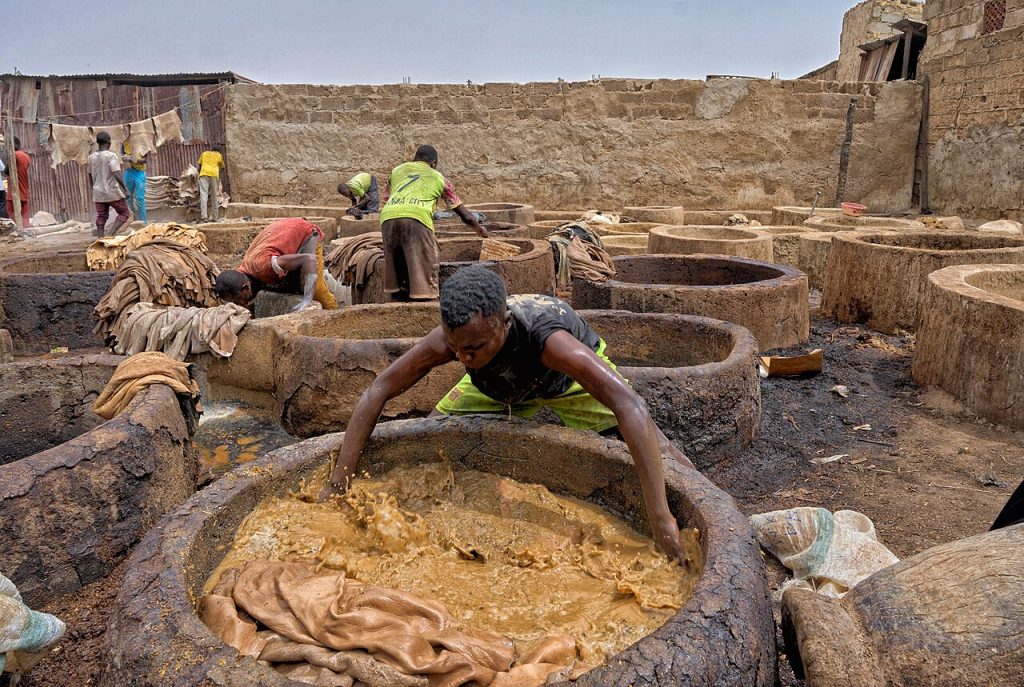
Vegetable tanning is the slowest way to turn a hide into leather, and the only method that leaves the material with a memory. A pit-tanned hide spends four to twelve weeks moving through baths of bark, water and tannin, each bath stronger than the last, while the collagen slowly binds and the skin stops being skin. What comes out is firm, pale, faintly of wood, and for a month or so almost impossible to work.
The pit and the calendar
The pits themselves are unremarkable: concrete tanks sunk into the floor of a shed that smells of wet bark and ammonia. A tanner suspends the hide on a frame and lowers it by hand, moving it every few days from the weakest liquor to the strongest, raising the concentration so gradually that the fibre takes the tannin without shock. Chestnut, oak, mimosa, quebracho, tara: each gives a different colour and a different final firmness, and the sequence matters as much as the recipe. The work is largely a matter of reading the liquor, the way a winemaker reads a fermentation, and it does not scale.
The arithmetic is unforgiving. A chrome-tanned hide is finished in about a day. Roughly nine out of ten hides in the world are chrome-tanned, because the process is fast, cheap, uniform and forgiving of imperfect skins. A pit-tanned side takes a month and a half, occupies floor space, consumes labour, and costs several times as much before anyone has cut a single strap. There is no version of this that becomes efficient.
What speed bought
Chrome tanning was a nineteenth-century industrial triumph and it remains one, in the sense that it turned a craft into a supply chain. It made leather soft, heat-resistant, consistent, and available in quantities that a pit tannery could never promise. It also moved the moment of judgment. With chrome, the character of the leather is decided at the tannery and sealed under a finish: corrected grain, sprayed colour, embossed texture. What arrives at the workshop is a product with a surface, not a material with a structure.
Vegetable tanning leaves the judgment to time. The hide keeps its grain, its scars, its slight unevenness of colour, and it continues to change after the object is sold. That continuation is either the whole point or an inconvenience, depending on what one is making. For a car seat or a phone case, it is an inconvenience. For a belt, a bag, a pair of soles, it is the reason the object is worth repairing.
The colour of time
A natural veg-tan belt begins the colour of oatmeal and ends, after two years of daily wear, somewhere near caramel; after five, closer to chestnut. The change is not uniform. It darkens where the hand rests, where the buckle rubs, where the sun falls, and the pattern is a diagram of habit. Oils from the skin, oxidation, a little rain, a little neglect: the material records all of it, slowly, and cannot be hurried without being faked.
Which is why the industry now fakes it. Pre-distressed leather, tumbled and oiled and drum-dyed to look as though it has lived, is one of the more honest dishonesties in luxury, because it admits what buyers want: evidence. The imitation is a confession that the patina is the product. A finish that imitates ten years of use is cheaper than ten years of use, and considerably easier to schedule.
The repair economy
Because the fibre is dense and the tannage runs through the hide rather than sitting on it, veg-tan leather can be cut back, re-stitched, re-edged, re-soled. A belt can be re-punched further along; a bag can take a new handle; a shoe can take three or four soles in its life if the welt is stitched rather than glued. None of that is possible with a corrected-grain leather whose surface would open at the first repair.
The infrastructure, though, is thin. Pit tanneries in Europe number in the low hundreds and employ people who are not being replaced. The skills are unglamorous and the margins are worse than unglamorous. A tannery survives by selling whole sides to ateliers that will use sixty or seventy per cent of the hide and write off the rest, which means the customer is quietly paying for the parts that were cut away.
The price of patience
There is also the matter of the animal. The best veg-tan comes from hides of mature beasts, slow-grown, with tight fibre and few scars, and those hides are a by-product of farming decisions made for reasons that have nothing to do with leather. Supply therefore moves with dairy quotas and beef prices, and the price of a good side swings accordingly. Nobody can plan a decade of production around a material whose quantity is set by another industry’s calendar.
That instability is the real reason chrome won, and it is also the reason veg-tan reads as luxury now. Scarcity here is not manufactured by a marketing department. It is the natural consequence of a process that refuses to compress.
Patina, properly understood, is not a finish but a record. It is the visible accumulation of decisions, most of them trivial, all of them made by whoever carried the object, and it can exist only in a material that remains, in some sense, answerable to its surroundings. A surface sealed at the tannery has nothing left to say.
The argument for vegetable tanning is therefore not nostalgia. It is that a material which cannot change cannot remember, and an object that cannot remember is not being kept. It is only being owned.