The Quiet Return of Bespoke Tailoring
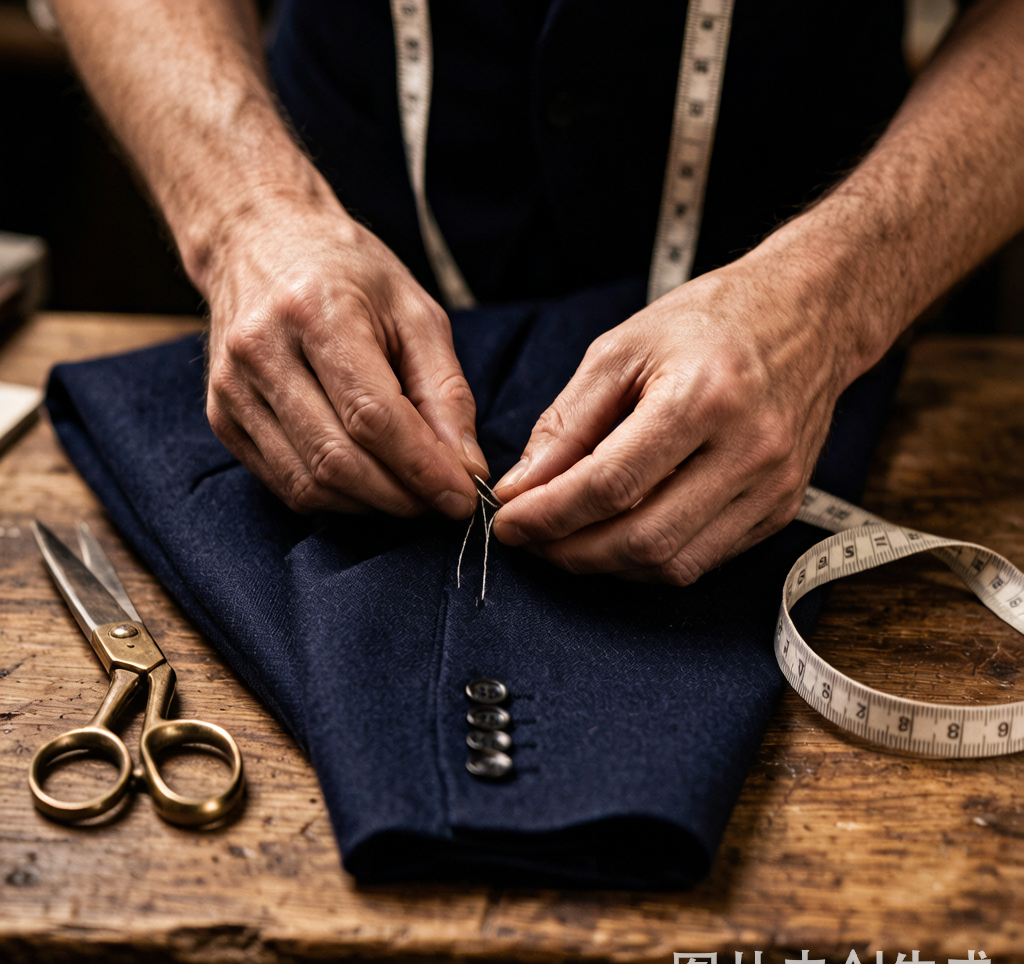
In a world addicted to speed, some men are rediscovering the radical luxury of waiting.
Walk into any Savile Row house on a Tuesday morning and you will find something the algorithm cannot replicate: a man with chalk in his hand, measuring the drop of your right shoulder against the left, making microscopic adjustments that no machine can account for. This is bespoke tailoring. After a decade of streetwear dominance, it is mounting the quietest comeback in menswear.
The Death of Hype
Let us be blunt: the sneaker-drop economy is exhausted. When every Tuesday brings another raffle, another queue, another bot-assisted checkout failure, the dopamine hit wears thin. The product that once signalled insider knowledge now signals fatigue. You are not a collector. You are a consumer being manipulated by the same scarcity mechanics used for concert tickets and limited-edition cereal boxes.
Bespoke clothing operates on the opposite principle. There is no drop date. No countdown. No resale market. There is only a date, six to eight weeks from your first fitting, when a garment made for your body alone will be ready. The waiting is the experience. The garment is the artifact.
The Geometry of a Good Jacket
A bespoke jacket is not merely a jacket. It is a negotiation between fabric, gravity, and the asymmetries of the human frame. A good cutter understands that no shoulders are level, that one arm hangs lower than the other, that the chest expands and contracts with every breath. The shoulder line is not straight. It is a subtle, engineered curve designed to make the straight appear natural.
This is why photographs rarely do bespoke justice. What you are paying for is not visible. It is the absence of tension across the back blades. The collar that hugs the neck without gaping. The sleeve pitch that lets you raise a glass without the entire jacket riding up. These are not aesthetic decisions. They are engineering decisions disguised as aesthetic ones.
Price as a Feature
A suit from a reputable Row house starts around 5,000. This figure shocks people conditioned to off-the-rack luxury pricing. But a single cutter spends roughly eighty hours on a two-piece suit. The fabric alone, from mills in Huddersfield or Biella, runs 500 to 800 per metre. Add central London overhead and the apprentice system that guarantees the craft survives another generation, and the margin starts to look almost reasonable.
More importantly, the price is a filter. Bespoke tailoring does not want to scale. It cannot scale. The entire proposition is scarcity. When you buy bespoke, you are buying the opposite of industrial luxury. You are buying something fewer than one in ten thousand men will ever own.
The Young Bespoke Client
The stereotype of the bespoke client, a banker in his sixties ordering another navy chalk-stripe, is dying. The new client is thirty-five, works in tech or media, owns exactly two suits. He has spent years in Japanese denim and archive hoodies. He has done the sneaker thing. Now he wants garments that communicate authority, not tribal affiliation.
These clients are reshaping the Row. Softer shoulders. Higher armholes. Jackets worn with jeans, a sartorial heresy a generation ago that is now standard practice. Houses that once insisted on full-canvas construction now offer half-canvas. The Row is not compromising. It is adapting to a client who knows exactly what he wants because he has spent years studying what he does not want.
The Bottom Line
Bespoke tailoring is not a trend. It is an antidote to trends. In a culture that cycles through aesthetics every six weeks, there is something provocative about commissioning a garment designed to look better at year ten than year one. The quiet return is not about more suits, but deeper ones. Not faster fashion, but slower. Not more clothes, but the right ones.