Why Knitwear Gauge Matters More Than the Fibre
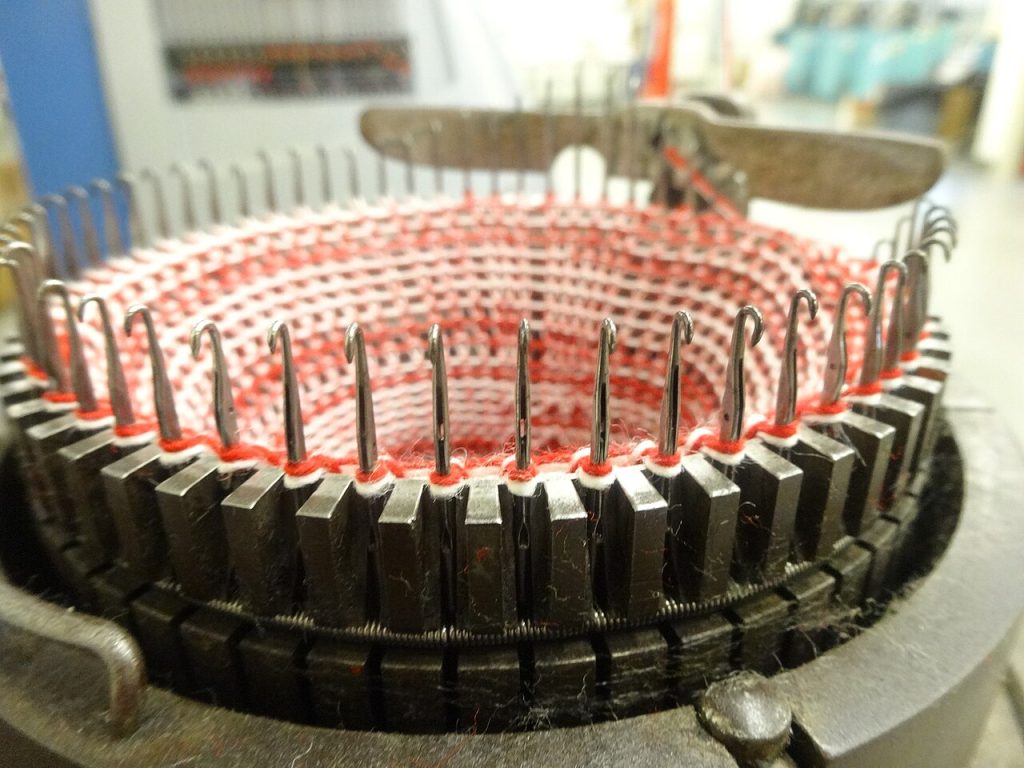
A sweater’s label talks about fibre because fibre is easy to name and easy to price. Gauge, the number of needles per inch on the machine that made it, decides almost everything the garment will do after the first wash, and it is almost never printed anywhere.
The count
Gauge runs from around one and a half needles per inch, which is a hand-framed chunky knit, through three, five and seven, to twelve and eighteen for the fine merino that sits under a jacket. The number describes the machine, not the yarn, but the two are locked together: a fine yarn on a coarse machine produces a loose, open fabric that will distort, and a thick yarn on a fine machine cannot be knitted at all. The pairing is what a knitter means by the count.
Yarn is specified the same way, in a system that reads as a fraction. A two-ply yarn of a certain metric count is written as two over twenty-eight, and the second number gives the fineness of the single strand before twisting. A finer yarn allows a finer gauge, which allows a denser fabric, which is the beginning of the chain that ends in how the sweater feels on a cold morning.
Fully fashioned or cut and sewn
The older method shapes each panel on the machine, widening and narrowing at the edges so that the piece arrives as a body, two sleeves and a neck, already in the silhouette. The panels are then linked stitch to stitch by hand, which takes twenty to forty minutes for a sweater and leaves a seam that stretches with the knit instead of fighting it. Almost nothing is wasted, and the shaping is visible at the edges as a line of small steps.
The modern method knits a continuous sheet and cuts the panels out with a blade, the way a shirt is cut from cloth. It is faster, cheaper, and it allows prints and intarsia that would be difficult to shape on the machine. The cost is waste at the cutting table and a cut edge that can curl and unravel, which is why cut-and-sewn knits are usually overlocked and often feel stiffer at the seam.
What tightness buys
A tight gauge, with the needles close and the yarn fine, produces a dense fabric with good recovery. It holds its shape through a season, resists pilling because the fibres are held in place, and drapes with a certain weight rather than clinging. It also takes longer to knit, uses more yarn for the same dimensions, and shows every irregularity in the spinning, which is why it is reserved for good yarn.
A loose gauge buys loft. Air is trapped between the stitches, so the sweater is warm for its weight and soft to the hand, and it drapes in a way that a dense knit cannot. The cost is dimensional instability: a loose knit grows with wear, the elbows bag, the hem stretches, and the surface pills faster because short fibres can work their way out of a slack structure. Neither is better. They are different contracts with gravity.
Linking and the seam
The seam is where a good sweater declares itself. A hand-linked seam joins loop to loop, matching the stitch pattern across the join, and it moves with the fabric. Turn a fully fashioned sweater inside out and the shoulder seam looks like a continuation of the knit; turn a cheap one and there is a ridge of overlocking and a line of cut loops. The difference is not visible from across a room and is obvious the first time the sweater is worn for six hours.
Shoulders deserve particular attention, because that is where weight hangs. Better makers tape the shoulder seam with a strip of stable tape or a narrow rib so that the seam does not stretch under the pull of sleeves and body. Without it, a soft knit grows at the shoulder within a season, and the whole garment slides out of position, which is a fault no amount of careful washing will correct.
Washing, milling and the label
Some knits are washed after making to bloom the yarn, which softens the surface and fills the space between stitches; some are milled, agitated in water until the fibres mat into felt. Both change the gauge after the fact, and both make the finished measurement unpredictable, which is why knitwear is measured after finishing rather than before. A label that says hand wash cold is often telling the buyer that the fabric has not been stabilised and will shrink or distort if treated like a sweatshirt.
Pilling is the least fair of the failures, because it depends on fibre length as much as on construction. Long-staple wool pills less because the fibres do not migrate; a soft, short-staple cashmere can pill heavily in a dense knit. The gauge modulates the effect but does not cause it, and a retailer who blames the customer’s washing is usually avoiding the more likely explanation, which is a specification chosen for hand-feel at the counter.
The cuff rib is where a sweater usually dies first, worn thin at the wrist and stretched by being pushed up the forearm. On a good one it is knitted at a tighter gauge than the body, sometimes with an elastane core, and it recovers when pulled. On a bad one it is a decorative band that gives up in a month, and the garment becomes something worn only at home, which is a quiet way of saying it was never quite right.